
Structural Roof Deck
The supporting deck may consist of concrete, metal, timber or an appropriately designed construction. Its structural capacity must suit the intended use.
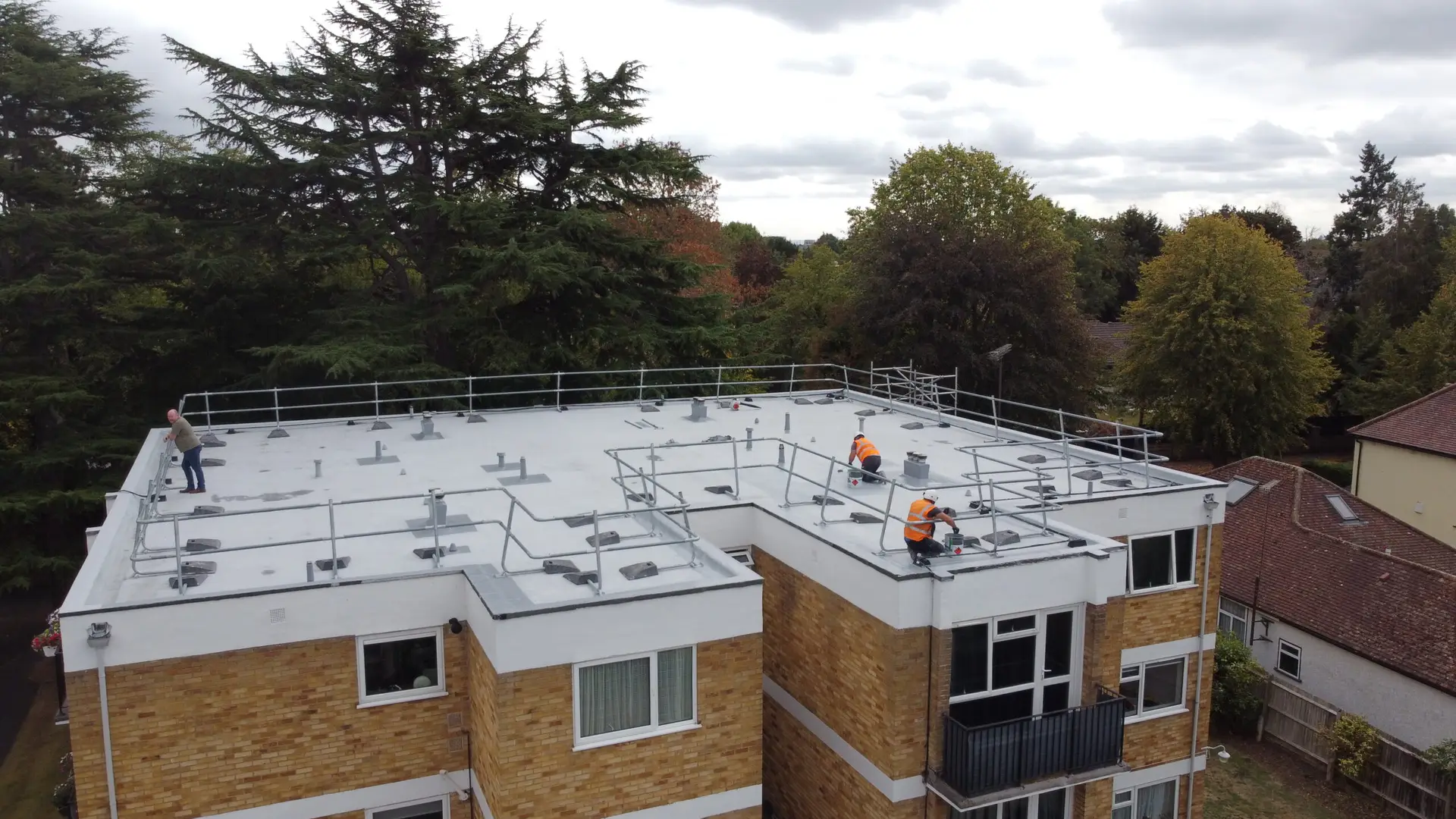
A comprehensive guide to flat roofing, its history, engineering, construction methods, waterproofing materials, advantages, common problems and continued importance throughout the United Kingdom.
From traditional bituminous coverings to modern single-ply membranes, reinforced resin systems and liquid-applied waterproofing, flat roofs have become an important part of commercial and industrial architecture.
A flat roof is a low-pitched roof construction designed to provide a continuous waterproof covering with controlled drainage.
Despite the name, properly designed flat roofs generally incorporate falls to direct rainwater towards outlets, gutters or other drainage arrangements.
Unlike many pitched roofs that shed water using overlapping slates or tiles, flat roofs typically rely upon a continuous waterproof membrane or covering.
Such coverings may consist of reinforced bituminous membranes, synthetic single-ply sheets, reinforced resin systems or liquid-applied waterproofing.
The waterproofing layer is only one element of the system. Structural decks, insulation, vapour-control layers, upstands, outlets and penetrations must also be correctly designed.
Flat roofs are used on commercial, industrial, retail, healthcare, educational and residential buildings throughout Britain.
Flat roofing is far from a recent invention. Low-pitched roofs have been used for thousands of years, while modern waterproofing developed through industrial manufacturing and material science.
Low-pitched roofs were used in ancient buildings across regions with suitable climates. Early systems relied upon locally available materials, including earth, clay, stone and natural bitumen.
Construction methods varied considerably according to climate and local resources.
Industrialisation brought developments in manufactured bituminous materials, roofing felts and more consistent production methods.
These materials enabled waterproof coverings to be installed over increasingly varied structures.
Reinforced bituminous roofing materials became established in commercial and industrial construction.
Architectural modernism also encouraged the use of flat roofs in new building designs.
Large-scale rebuilding increased the use of flat roof construction in schools, hospitals, factories and commercial premises.
Polymer development encouraged new synthetic waterproofing systems alongside established bituminous coverings.
Improved bituminous membranes, synthetic single-ply systems, reinforced resins and liquid-applied products increased the range of roofing solutions.
Thermal performance and condensation control became increasingly important considerations.
Flat roofing has continued to develop through improved insulation, waterproofing, fire performance, drainage design and material testing.
Modern applications include commercial roofs, roof terraces, green roofs and systems designed to accommodate photovoltaic installations.
The long-term performance of a flat roof depends on the complete roofing assembly, not simply the outer waterproof covering.
Simplified warm-roof cross-section. Layer thicknesses, falls, support, fixings and membrane configuration vary by system.
The supporting deck may consist of concrete, metal, timber or an appropriately designed construction. Its structural capacity must suit the intended use.
Where required, a vapour-control layer helps manage moisture transfer within the roof assembly.
Suitable insulation contributes to building energy performance and may incorporate tapered falls.
The external layer forms the principal weatherproof barrier, with compatible joints, upstands, outlets and penetrations.
A properly designed flat roof should account for falls, deflection, drainage outlets, overflow arrangements and the possibility of water accumulating at low points. Design should follow the applicable version of BS 6229 and relevant manufacturer requirements.
Flat roofs are widely used because they provide design flexibility and can accommodate a range of structural, waterproofing and insulation solutions.
Low-pitched roof geometry can suit modern commercial architecture and large building footprints.
Properly designed flat roofs can accommodate mechanical equipment, ventilation systems and other building services.
A range of membrane, bituminous and liquid-applied systems are available for different project requirements.
Appropriate roof refurbishment can create opportunities to improve thermal performance.
Certain existing roofs may be suitable for local repair or compatible overlay systems rather than full strip-off.
Subject to engineering, waterproofing and access requirements, flat roofs can support terraces, green roofs or solar equipment.
Flat roofs can be waterproofed using different technologies. Each has distinct materials, installation methods, performance characteristics and refurbishment considerations.
Torch-on felt is a form of reinforced bituminous roofing membrane applied using heat, often as part of a multi-layer waterproofing system.
Modified bitumen membranes are frequently used for commercial and industrial flat roofs.
Correct substrate preparation, lap bonding, detailing and fire-safe installation are critical.
Explore Torch-on Felt →Single-ply roofing uses a manufactured waterproof membrane, commonly including PVC, TPO or EPDM systems.
Membranes can be mechanically fixed, adhered or installed using other approved system methods.
Joint formation and installation requirements vary according to membrane chemistry.
Explore Single-ply →Silicone-based roof coatings are liquid-applied materials that cure to form a protective elastomeric layer.
Certain systems are used for restoration of suitable existing roofing substrates.
Surface condition, adhesion, moisture, preparation and system certification must be considered.
Explore Silicone →Glass-reinforced plastic roofing combines resin with glass-fibre reinforcement to form a rigid waterproof layer.
GRP is widely used in selected flat roof and balcony applications.
Correct deck preparation, reinforcement, curing and movement detailing are essential.
Explore GRP →Liquid-applied coatings encompass several waterproofing and protective technologies, including polyurethane, acrylic and other resin-based systems.
Depending on the system, they may be used for new waterproofing or refurbishment of suitable roofs.
Coating compatibility, reinforcement, weather conditions and preparation requirements vary.
Explore Roof Coatings →Silicone is itself one type of liquid-applied coating. We have separated it here because it merits a detailed guide of its own. Likewise, not every roof coating is a complete certified waterproofing system. The product's intended use and approval must be checked.
Flat roofs can provide long-term waterproofing, but defects in drainage, detailing, materials or installation can eventually result in water ingress.
Water entering a building may travel through insulation and roof components before becoming visible internally.
The location of an internal leak therefore does not always identify the original roof defect.
Ageing membranes, failed joints, poor upstand details, defective outlets and moisture trapped within roofing systems may all contribute to deterioration.
The correct diagnosis is essential before choosing a repair or replacement approach.
Poor falls, structural deflection or blocked outlets can allow standing water to accumulate.
Ageing, punctures, defective seams or incompatible repairs may compromise waterproofing.
Blisters can form where moisture or gases become trapped beneath certain roofing materials.
Poorly detailed junctions, parapets, outlets and penetrations may create paths for water ingress.
Water within the roof build-up can reduce thermal performance and damage materials.
Building movement, unsuitable foot traffic and mechanical activity can affect the roofing system.
Not every leaking flat roof requires immediate complete replacement. The correct approach depends on the cause and extent of deterioration.
Some roofs are suitable for targeted repairs, joint treatment or a compatible waterproofing overlay. Others require removal and reconstruction because the existing build-up is unsuitable.
Establish the existing roof construction, waterproofing type, condition and likely sources of leakage.
Determine whether moisture has entered the roof build-up and whether the substrate is suitable for further treatment.
Repair appropriate membrane defects, outlets, upstands or penetrations where feasible.
Compatible liquid-applied systems may provide refurbishment options for suitable existing roofing materials.
Appropriate refurbishment may incorporate thermal insulation improvements and drainage upgrades, subject to design.
Seriously deteriorated, moisture-saturated or structurally unsuitable roofs may require stripping and rebuilding.
Successful waterproofing depends on suitable substrate preparation, material compatibility and correct installation. Applying a new coating over wet or deteriorated materials does not automatically remedy the underlying defect.
The five systems differ in material composition, installation method and intended applications.
| System | Material | Typical Application | Key Consideration |
|---|---|---|---|
| Torch-on Felt | Reinforced bituminous membrane | New or refurbished flat roofs | Heat application, detailing and fire safety |
| Single-ply | Synthetic sheet membrane | Commercial and industrial roof systems | Approved fixing and jointing methods |
| Silicone | Silicone elastomeric coating | Selected compatible refurbishment substrates | Adhesion, surface preparation and certification |
| GRP | Glass-fibre-reinforced resin | Selected flat roofs and balconies | Deck stability, curing and movement |
| Coating | Liquid-applied protective or waterproofing materials | Suitable new or existing roof substrates | Compatible specification and certified intended use |
Flat roofing remains important to British commercial, industrial and public-sector buildings, both through new construction and the maintenance of existing property.
Retail buildings, offices and leisure premises frequently incorporate flat roof areas and associated building services.
Industrial buildings may require flat waterproofing systems over plant rooms, extensions and other roof areas.
Hospitals, schools and public buildings often contain existing flat roofing that requires inspection and maintenance.
Roof refurbishment may create opportunities for insulation upgrades and improved building thermal performance.
Flat roof systems require inspection, drainage maintenance, leak investigation and periodic remedial work.
Property owners must balance refurbishment cost, replacement needs, disruption and long-term performance.
Flat roof expenditure varies substantially by area, substrate, insulation, access, chosen waterproofing and the condition of the existing roof. There is no single universal cost or service-life figure applicable to every system.
Flat roofs can present serious risks during inspection, maintenance and construction.
The absence of a steep roof pitch does not make work at height inherently safe.
Roof edges, openings, skylights and deteriorated decking require appropriate protection.
Torch-applied bituminous systems also introduce fire risks that require suitable controls and planning.
The roof must be assessed before access, with safe systems of work established by competent personnel.
Safe access, edge protection and fall-prevention measures must be planned.
Rooflights and deteriorated roof decking may be unable to support a person's weight.
Torch-applied roofing requires appropriate fire precautions and competent installation.
Roofing works must account for people, equipment and business operations beneath the roof.
Generally, no. Modern flat roofs are designed with falls to move water towards suitable drainage. The required design depends on the roof construction and applicable guidance.
There is no single best solution for every building. The choice depends on the substrate, intended use, roof geometry, thermal requirements, expected performance and project budget.
Some roofs can be refurbished with compatible liquid-applied systems, but the source of leakage and the condition of the existing materials must be assessed first.
Single-ply roofing typically uses a manufactured synthetic membrane, while traditional felt systems use reinforced bituminous membranes, often installed in multiple layers.
Silicone is one chemistry within the broader liquid-applied coatings category. Different products have different compatibility, performance and installation requirements.
Replacement may be appropriate where the existing materials are extensively deteriorated, saturated or unsuitable for further refurbishment. The decision requires a roof-specific assessment.
This guide provides general educational information. Flat roof design and refurbishment should follow applicable standards, product certifications and competent professional assessment.
Educational content prepared: November 2026. Relevant guidance includes BS 6229:2025 and manufacturer-specific installation requirements.
Elite Waterproofing provides commercial and industrial flat roof repair, refurbishment and replacement services.
Whether your existing roof is affected by water ingress, ageing waterproofing, failed detailing or general deterioration, our team can discuss the appropriate next steps.
Request a Free Quote